We believe that lasting change comes from within communities — not from the outside. Our civil society support model is built on the conviction that local organizations, when given the right environment to grow, can become powerful drivers of democratic life, accountability, and social cohesion.
Reclaiming Civic Spaces
At the heart of our approach is a structured incubation model: a 6–12 month capacity development journey that combines technical training, one-on-one coaching, small grants, and peer networking. Rather than one-off workshops, we walk alongside organizations at every stage of their development — from establishing governance structures and financial management systems to designing and implementing community programs. As organizations graduate, many continue with follow-up grants and longer-term accompaniment, enabling them to grow into independent, credible actors in their own right.
To make this support tangible and accessible, we establish Civil Society Support Centers — physical and online hubs where civil society actors can access resources, find community, receive training, and connect with peers and decision-makers. These centers are more than offices: they are open spaces for civic life, where coalitions form, ideas are tested, and voices are amplified. Our hybrid model — combining in-person centers with digital platforms — allows us to reach organizations in areas that are difficult to access, extending support well beyond any single location.
Our sub-granting facility complements the incubation program, providing downstream partners with financial support, compliance guidance, and strategic oversight aligned with the standards of major institutional donors. We have managed grant portfolios at scale, offering partners not just funding, but the systems and knowledge to manage it responsibly. Across all our support, we apply a transparent, tiered partner selection process — ensuring that resources flow to where they are most needed and will have the greatest effect.
This model is designed to be transferable. The principles that underpin our civil society support work — locally rooted design, graduated funding, long-term accompaniment, and community ownership — are applicable in any context where civic space is under pressure and organizations are striving to grow.
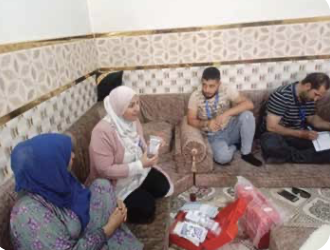
‘These centres offer a vital space for civil society actors to receive assistance and build solidarity. “Daam Center is a small, warm house that never closes its doors.”
One of the trainees noted.
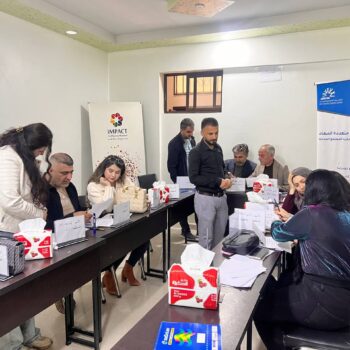
In Raqqa and Deir ez-Zor more than 70 capacity-building workshops were conducted, along with over 230 technical support sessions. These initiatives benefited 61 organizations and more than 800 individual participants. The total number of direct and indirect beneficiaries of the funded projects exceeded 55,000.
Over 65 networking sessions were facilitated within and beyond incubation programs, engaging more than 700 civil society actors, partners, government entities, and other stakeholders from Raqqa and Deir ez-Zor.
Through a tiered partner selection process, IMPACT has awarded 145 grants, ranging from $10,000 for nascent initiatives to $900,000 for more established organizations. Our holistic, learning-by-doing approach ensures contextually relevant, locally-rooted interventions.
Grants management and civil society support form the backbone of IMPACT’s funding. To date, the grants and compliance team has managed over $9 million, with an additional $5 million planned for 2025.
Inclusive societies are built when the people most affected by decisions have a genuine role in making them. We design our programs from the ground up to ensure that women and young people are not just participants — they are leaders, advocates, and agents of change.
Our approach to gender and youth inclusion is not a checkbox or an add-on: it is a structural methodology embedded across our entire programming cycle. From the earliest phase of needs analysis through to recruitment, program design, safe space creation, and evaluation, we apply a deliberate inclusion lens — asking at every stage who is in the room, who is missing, and what barriers prevent them from participating.
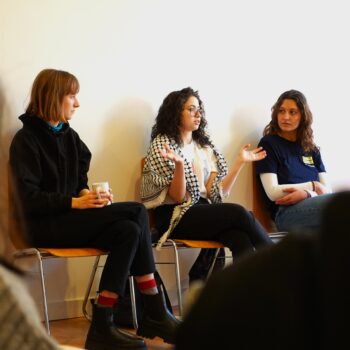
For women-focused organizations, we apply our civil society incubation model with specific adaptations: creating safe dialogue environments that connect grassroots women’s initiatives with decision-making spaces, providing technical and financial resources tailored to the realities women-led organizations face, and building policy advocacy capacities on gender equality. Our Spaces program brings together women from across the civic spectrum — from frontline activists to organizational leaders — to exchange knowledge, build collective power, and influence the policies that shape their communities.
For youth, our programs focus on building genuine civic agency. Through leadership development, community dialogue facilitation, and the design and implementation of locally identified initiatives, we equip young people with the practical skills and institutional connections they need to engage meaningfully in public life. Our experience shows that when young people are trusted with real responsibilities and given structured mentorship, they become credible and sustained voices in their communities — not just at the end of the program, but long after.
Our inclusion methodology is designed to function in complex and fragile contexts, where traditional gender norms and limited youth participation are common challenges. It is adaptable, evidence-informed, and grounded in respect for community dynamics — making it a model that can be applied wherever women and youth remain underrepresented in civic and political life.